
Buying Your First Skis? You Wouldn’t Learn to Drive in a Race Car.
The feeling is undeniable. You see someone arcing perfect turns down a groomer, you feel the call of a powder day, or you’re simply tired of the rental line shuffle. The time has come: you want your own skis. But the moment you start browsing, you’re hit with a technical vocabulary that seems borrowed from an aerospace engineering textbook: sidecut, turn radius, construction profile, rocker…
Don’t let the overwhelm win. Buying skis isn’t rocket science; it’s more like finding the perfect pair of running shoes. You need to know what terrain you’ll be on and what your true size is. Because let’s be brutally honest: you wouldn’t learn to drive in a high-performance race car. A race car is built for precision at incredible speeds, and in the hands of a novice, it’s uncontrollable and dangerous. The same is true for skis. A pair of stiff, aggressive race skis is the perfect recipe for frustration, not fun, if you’re still mastering the basics.
Let’s decode this language together, from one skier to another.
First, Take Off the Goggles: Who Are You on the Snow?
The mountain doesn’t judge, so don’t judge yourself. Being honest about your ability isn’t a sign of weakness; it’s a sign of intelligence. It’s the key to choosing skis that will help you improve, not ones that will fight you on every run.
- The Cautious Explorer (Beginner): You’re still building a relationship with the snowplough and dreaming of linking parallel turns. Your main goal is confidence and control. You need a docile partner: soft, lightweight skis designed to forgive mistakes and initiate turns with ease.
- The Groomer Crusader (Intermediate): You’ve unlocked the parallel turn. Blue runs are your domain, and reds no longer intimidate you. You’re looking for a ski that provides more stability as you gain speed and bites a little harder into the snow as you start to lean into your turns.
- The Master of the Mountain (Advanced/Expert): The entire mountain is your canvas. You carve with precision, float through powder, and read the terrain instinctively. You need a precision tool—a ski that responds instantly to your input and delivers maximum performance in your chosen discipline.
Tell Me Where You Ski, and I’ll Tell You Which Skis You Need
There’s no magic “one ski” that’s perfect for everything. Your favorite playground dictates the right tool for the job.
- The Corduroy Connoisseur (Piste / Carving): Your perfect day involves leaving clean trenches on freshly groomed snow. You need a narrower ski with a strong camber profile that’s agile and grips ice like a vice. It’s all about precision and energy.
- The Adventurer (All-Mountain): You love the groomers, but if there’s fresh snow, you’re the first to explore the edges of the trail. You need the Swiss Army knife of skis: a balance between hard-snow agility and soft-snow float. These are the ultimate all-rounders.
- The Powder Hunter (Freeride): You live for the next big storm. Your goals are flotation and high-speed stability in variable terrain. Wide waists and rockered profiles rule here, turning the mountain into a snowy surf break.
- The Acrobat (Freestyle / Park): The terrain park is your home. Jumps, rails, and features are your language. You’re looking for twin-tip skis for riding forwards and switch, a playful flex, and bombproof construction to withstand the abuse.
The Personality Underfoot: Decoding Rocker & Camber
If you lay a ski on a flat surface, its side profile tells you everything about its character.
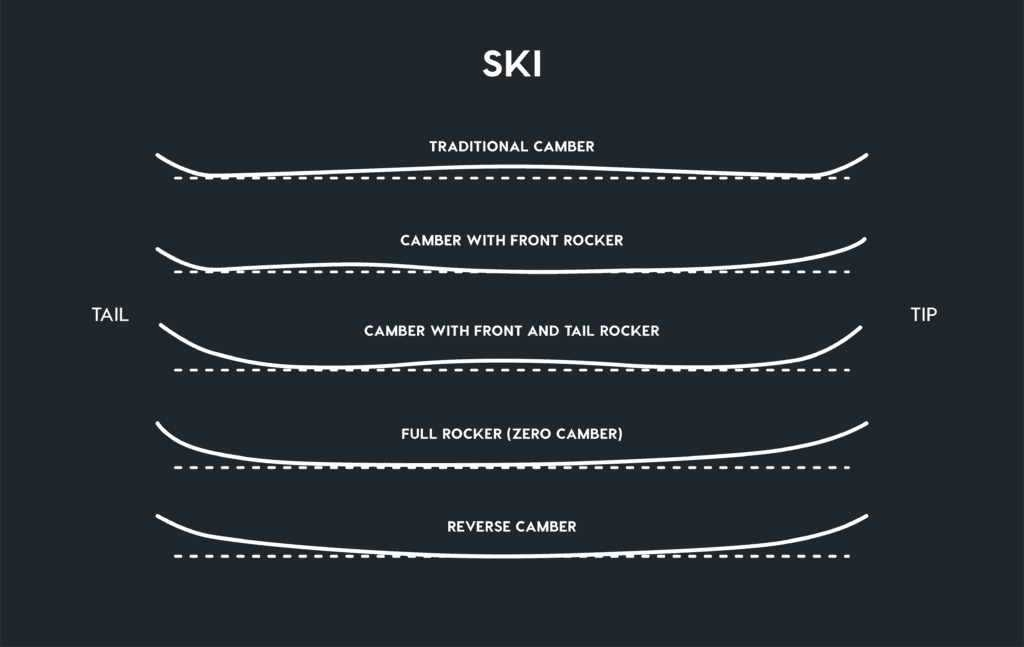
1. Traditional Profile (Camber)
- The DNA: The classic upward arch under the foot. When you apply weight, the ski distributes pressure along the entire effective edge.
- Its Behavior: It’s synonymous with grip. It bites into hardpack with the tenacity of a pitbull and springs you from one turn to the next with explosive energy.
- Its Ideal Owner: The on-piste skier who values precision and responsiveness above all else.
2. Hybrid Profile (Rocker/Camber/Rocker)
- The DNA: It keeps that grippy camber underfoot but raises the tip (and often the tail) off the snow prematurely.
- Its Behavior: The chameleon. The rockered tip helps you start turns smoothly and gives you extra float in soft snow. The camber in the middle ensures you don’t lose grip when you need it.
- Its Ideal Owner: The vast majority of skiers. This is the engine behind all-mountain and many freeride skis due to its incredible versatility.
3. Reverse Profile (Full Rocker)
- The DNA: A continuous, gentle curve, like the base of a rocking chair.
- Its Behavior: Think “boat hull.” Its purpose is to float and pivot with effortless ease. It’s the undisputed king of deep powder. On hardpack, it feels looser and less precise.
- Its Ideal Owner: The freeride addict seeking maximum flotation or the true beginner who wants a ski that practically turns itself.
Finding Your Ski Length: A Formula Based on Height and Skill
Forget any “rule” about the ski coming up to your chin or nose. Modern ski technology has made that advice obsolete. The best way to find your length is to use your height as a baseline, and then adjust based on your skill level and intentions.
Think of it this way: a shorter ski is easier to turn but less stable at speed. A longer ski is a powerhouse of stability but requires more skill and force to maneuver.
Step 1: Find Your Baseline
Start with your height in centimeters. This is your neutral reference point.
Step 2: Adjust for Your Ability Level
- Beginner: You want maneuverability above all else. A shorter ski is easier to pivot, control at slow speeds, and build confidence with.
- Calculation: Your Height in cm minus 10 to 15 cm.
- Intermediate: You have the fundamentals down and are starting to ski faster and more dynamically. You need a balance of agility for progressing your turns and stability for when you pick up speed.
- Calculation: Your Height in cm minus 5 to 10 cm.
- Advanced/Expert: You generate speed and power, and you need a ski that can keep up. A longer platform provides the stability you need for high-speed carving and floating through deep snow.
- Calculation: Your Height in cm, or even plus 5 cm.
Step 3: Fine-Tune Your Choice
Consider these factors to nudge your choice to the shorter or longer end of your recommended range:
- Go shorter if: You are significantly lighter than average for your height, or you prefer making very quick, short turns.
- Go longer if: You are heavier than average for your height, you plan to do a lot of off-piste/powder skiing (length = float), or you love skiing fast with big, sweeping turns.
The Numbers That Matter: Waist Width & Turn Radius
- Waist Width: The measurement at the narrowest point of the ski.
- A Scalpel (< 85mm): For surgical precision on groomers.
- An All-Terrain Vehicle (85-100mm): To move seamlessly between on-piste and off-piste.
- A Surfboard (> 100mm): To float on top of the deepest Niseko powder.
- Turn Radius: The ski’s natural turning arc, measured in meters.
- Short (<16m): Loves quick, tight turns. Very agile.
- Long (>22m): Prefers wide, sweeping turns and offers more stability at high speeds.
In the end, choosing your skis is a dialogue between you and the mountain. Don’t be dazzled by the model your hero rides. Think about the skier you are today and the one you want to become. The right tool won’t just make you a better skier—it will amplify the fun tenfold. And to truly fast-track your progress on that new equipment, a lesson with one of our professional instructors here at Snow Instructors Niseko can make all the difference in finding your confidence and style.
Remember, the best skis are the ones that make you forget you’re even wearing them. See you on the mountain.